
HEARIN / collection
4. The Qin Dynasty: A History of China
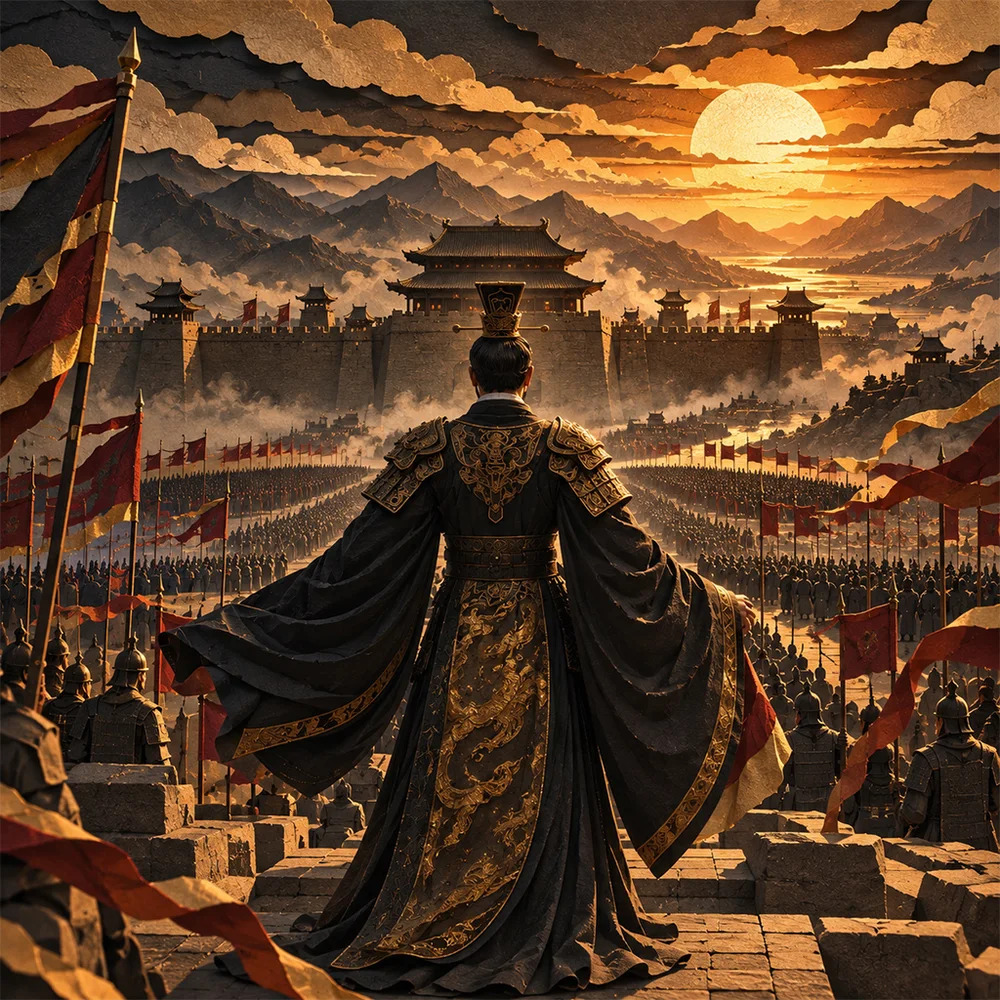
A man once decided that the word “king” was no longer impressive enough for him. So he invented a new one. Not just any word, mind you. He carefully stitched together pieces of ancient legend, the Three Sovereigns and the Five Emperors, and from that cosmic vocabulary created something entirely new. Huangdi. Emperor. That decision, made at a banquet in 221 BCE by a young conqueror named Ying Zheng, would shape the political language of China for more than two thousand years. And if that so
Continue reading the collection description
unds more like the opening of a myth than a history book, well, you are already beginning to see the strange charm of this story. Because the history of the Qin dynasty, the subject of this book, is full of moments like that. Moments when ambition borders on madness, when brilliance sits uncomfortably beside brutality, and when decisions made by a single individual ripple across centuries. But before we go any further, let me make a small confession. When people first hear the words “Qin dynasty,” they usually think of two things. The Great Wall. And a tyrant. The tyrant, of course, is Qin Shi Huang, the First Emperor. He is remembered for burning books, burying scholars alive, forcing millions into labor, and ruling with laws so harsh that even a minor mistake could lead to mutilation or execution. It is not exactly a flattering résumé. For generations, Chinese historians, many of them scholars who understandably took a dim view of being buried alive, have portrayed him as the ultimate despot. In their telling, Qin Shi Huang is the villain of the story: a ruler so obsessed with control that he tried to erase the past itself. And yet… History, like people, rarely fits neatly into simple labels. Because the same emperor who burned books also standardized the written language across a vast territory. The same ruler who crushed dissent also unified weights, measures, currency, and roads. The same man who terrified scholars created the administrative framework that would govern China for the next two thousand years. So which was he? A tyrant? A visionary? A monster? A genius? The uncomfortable, and therefore interesting, answer is that he was all of those things at once. And that complexity is exactly what makes this story worth telling. Now imagine the world before Qin Shi Huang. China was not yet “China” in the way we think of it today. Instead, it was a patchwork of rival kingdoms, Han, Zhao, Wei, Chu, Yan, and Qi, locked in centuries of warfare. Alliances formed and collapsed. Kings rose and fell. Entire states vanished. It was a political landscape that would look familiar to anyone who has studied ancient Greece or Renaissance Italy: brilliant, competitive, endlessly violent. Into this world stepped a young king from the western state of Qin. Within a few decades, he accomplished something that had eluded rulers for generations. He conquered all of them. That achievement alone would have secured his place in history. But Qin Shi Huang was not the sort of person who stopped after achieving the impossible. No. Once he unified the world, he decided to reinvent it. He created the title Emperor. He abolished the old feudal system. He standardized language, currency, and measurement. He built vast roads stretching thousands of kilometers across the empire. And he attempted something even more ambitious: a political system in which all power flowed directly from the center, from the emperor himself. For the first time, a unified Chinese state existed not just as a conquest, but as an administrative machine. That machine would outlive the Qin dynasty itself by centuries. Which brings us to another irony. For all its enormous ambition, the Qin dynasty lasted only two emperors. Just two. After Qin Shi Huang died, the empire he built collapsed in a storm of rebellions. Out of that chaos emerged two unforgettable figures: Liu Bang, a former village officer with a talent for survival, and Xiang Yu, a warrior so formidable that later generations would call him the Overlord of Western Chu. Their rivalry would decide the fate of China. Their war would produce some of the most dramatic episodes in ancient history: ambushes, betrayals, desperate battles, and one of the most famous last stands ever recorded. At one point, surrounded by enemies and hearing songs from his homeland drifting across the battlefield, Xiang Yu realized the war was lost. So he sang a farewell song to his beloved Yu Ji. And then he rode out to die. Moments like that are why this period has never really faded from cultural memory. They appear in poems, operas, novels, and films again and again, because the story itself feels larger than life. But if you are expecting a neat heroic tale where the good guys win and the bad guys lose, I should warn you now: that is not how history works. The people who built the Qin Empire were ruthless. The people who destroyed it were not necessarily kinder. And the people who inherited it, the founders of the Han dynasty, would spend centuries arguing about what the Qin dynasty had truly meant. Was it a cautionary tale about tyranny? Or the bold experiment that made imperial China possible? That debate still has not fully ended. In the pages ahead, we will follow the story from the beginning. We will meet Qin Shi Huang at the moment he decides to create the title Emperor and reshape the political universe around him. We will watch as his government introduces reforms that will influence Chinese civilization for two millennia. We will see the darker side of his rule: the paranoia, the brutality, the infamous burning of books and burying of scholars. And finally, we will witness the collapse of the empire he worked so hard to build, as rebellion spreads across the land and new leaders rise from the chaos. Along the way, you will encounter scholars who argue with emperors, generals who gamble entire armies on impossible strategies, and rulers who make decisions that echo for centuries. Some of them will be brilliant. Some will be reckless. A few will be both at the same time. Which, if we are honest, is usually how history works. One last thing before we begin. This book is not meant to be a textbook. You will not find long academic debates about footnotes or theoretical frameworks here. What you will find are stories, grounded in historical sources, but told the way people once told them around fires, in courts, and later on theater stages. Because ancient history was never just a collection of dates. It was a series of human dramas. And few dramas are as strange, ambitious, and consequential as the rise and fall of the Qin dynasty. So let us go back to that banquet in 221 BCE. A conqueror has just unified the known world. He stands before his ministers with a simple problem. “King,” he says, almost thoughtfully, “is no longer a big enough title.” What happens next will reshape China for the next two thousand years.
This page presents the cover and public catalog information. Read or listen to the content in Hearin.
Discover the Hearin app ↗Episodes in this collection
- 01
The First Emperor and His New Order
- 02
The Burning of Books and the Burying of Scholars
- 03
Great Reforms, Greater Suffering
- 04
The Fall of the First Empire
- 05
Sparks of Rebellion
- 06
The Rise of Xiang Yu and Liu Bang
- 07
The Rise and Fall of Xiang Liang
- 08
Liu Bang Rises
- 09
Xiang Yu’s Rise
- 10
The Race to Guan Zhong
- 11
The Fall of Qin
- 12
The Banquet at Hongmen
- 13
Burn the Roads Behind You
- 14
From Humiliation to Greatness
- 15
The Rise of Han Xin and Chen Ping
- 16
The Battle of Pengcheng
- 17
The Turning Point of the Chu–Han War
- 18
Han Xin’s Choice
- 19
The Fall of Xiang Yu and the Rise of Han