
HEARIN / collection
1. The Origins of Chinese Civilization: A History of China
A woman steps into a giant footprint in the mountains and becomes pregnant. A ruler tastes hundreds of unknown plants—some nourishing, some deadly—until he collapses from poison in the name of discovery. A king lights emergency beacon fires meant to summon armies… simply to make his favorite concubine laugh. If those moments sound like the opening scenes of a myth rather than the beginning of a civilization, well—you’re absolutely right. And yet, in China’s cultural memory, these strange, dra
Continue reading the collection description
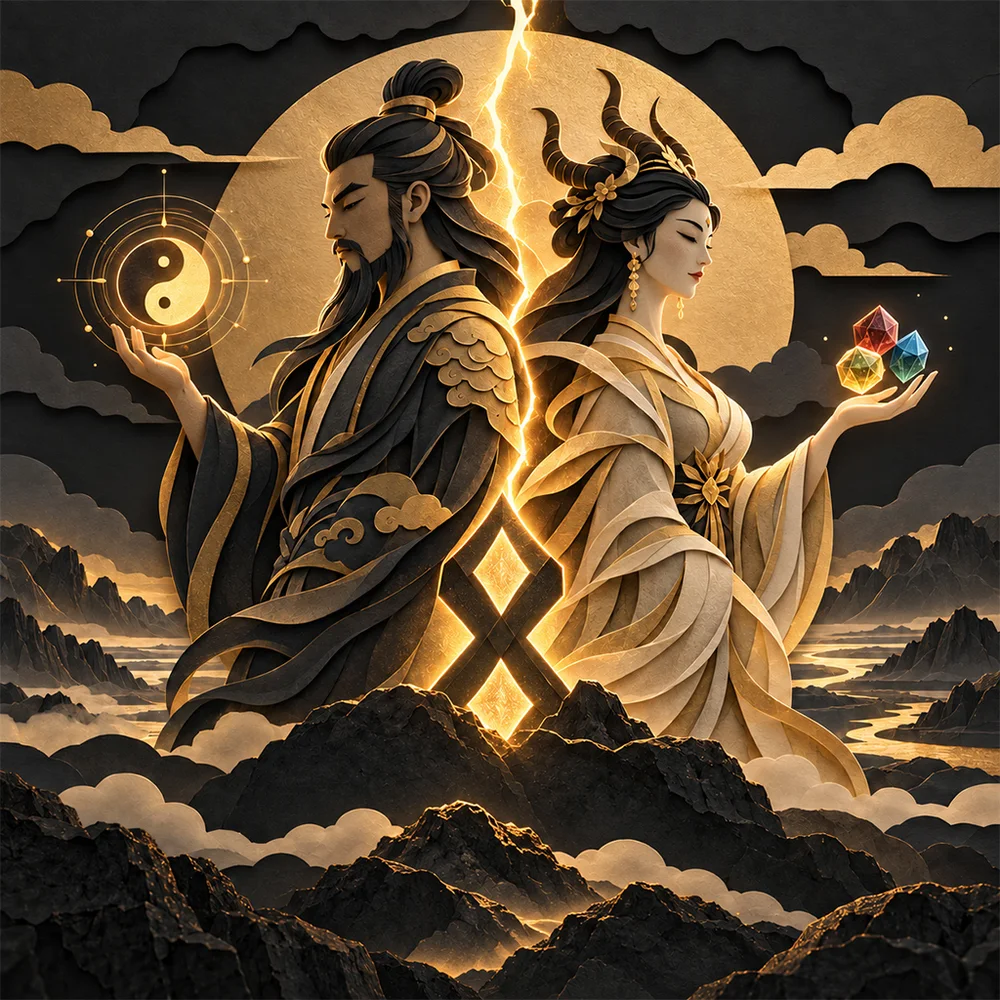
matic stories sit right at the very start of history. China is often described as having five thousand years of civilization. You’ve probably heard the phrase before. It appears in textbooks, speeches, documentaries, and museum exhibits. But the moment you stop and ask a simple question—where exactly do those five thousand years begin?—the answer becomes wonderfully complicated. Because the earliest chapters of Chinese civilization live in a place where history and myth blend together. Archaeology gives us tools, pottery, bones, and fragments of writing. Ancient texts give us stories—sometimes sober, sometimes fantastical—about culture heroes who taught people how to live. Somewhere between those two sources lies the dawn of one of the world’s longest continuous civilizations. This book begins right there. We start in a time so distant that the boundary between fact and legend almost disappears. In these early stories, you will meet figures known collectively as the Three Sovereigns and Five Emperors—culture heroes who, according to tradition, introduced the skills that allowed human society to flourish. Take Fuxi, for example. His story begins with that mysterious footprint in the mountains. When a tribal leader named Huaxu stepped inside it, legend says she conceived a child who would grow into a teacher of humanity. Fuxi is credited with discovering patterns in nature—patterns later expressed through the famous yin and yang symbol and the Eight Trigrams, ideas that would eventually influence Chinese philosophy, cosmology, and even medicine. But Fuxi was not only a philosopher. In the stories, he is also a practical innovator. He invents fishing nets after observing a spider’s web. He encourages animal domestication. He establishes early marriage customs to bring order to human relationships. In short, he represents a moment when people began transforming raw survival into something recognizable as civilization. Then comes Nüwa, a figure who manages to be both tender and cosmic at the same time. In one tale, she creates humanity from yellow clay. Carefully molded figures become the ancestors of noble families, while splashes of mud from a rope create ordinary people. In another story, she performs an act that feels almost cinematic: after a catastrophic battle shatters one of the pillars of heaven, she melts five-colored stones and patches the sky itself. Whether we read these stories literally or symbolically is not really the point. Myths rarely operate like newspaper reports. Instead, they preserve memories about how people once understood the world—its disasters, its mysteries, and their place within it. And sometimes those myths hide surprisingly practical ideas beneath their poetic surfaces. Consider Shennong, the “Divine Farmer.” According to tradition, he personally tasted hundreds of plants to discover which ones were edible and which were poisonous. Imagine that job description for a moment. Every meal might be the one that kills you. Yet from that risky experimentation came the beginnings of agriculture and herbal medicine. The story captures a real transformation in human history: the shift from hunting and gathering toward farming. It also hints at something deeply admirable—curiosity powerful enough to risk death in pursuit of knowledge. From there, the narrative grows larger. Enter the Yellow Emperor, Huangdi. If Shennong represents agricultural civilization, Huangdi represents political organization and cultural unity. Later Chinese people often described themselves proudly as the “descendants of Yan and Huang”—Yan referring to the lineage of Shennong, and Huang to the Yellow Emperor. In mythic history, Huangdi appears as a brilliant leader who helps unite scattered tribes, defeats rival powers, and establishes institutions that echo through later centuries. Whether every detail is historical is less important than the idea he embodies: the dream of a unified cultural community. From these legendary beginnings, the story gradually becomes more recognizable as history. We meet the sage kings Yao and Shun, remembered not for military conquest but for humility and moral leadership. Their reigns introduce an idea that will echo throughout Chinese political thought: that virtue, not birth alone, legitimizes power. Then comes Yu the Great, whose struggle against catastrophic floods reads like an epic. Instead of trying to block the waters with dams, Yu famously channels them through an enormous network of waterways. His success becomes the foundation myth of China’s first dynasty—the Xia. Now, historians still debate how clearly the Xia dynasty appears in the archaeological record. That uncertainty is part of the fun—and the challenge—of studying very early history. But whether entirely historical or partly legendary, the story reflects something real: the growing complexity of organized society. After Xia comes the Shang dynasty, where the evidence becomes clearer. Archaeologists have uncovered royal tombs, bronze ritual vessels, and oracle bones covered with early Chinese writing. Suddenly, we are no longer dealing only with stories. We are dealing with a civilization that left physical traces behind. And then the Zhou dynasty rises. Among its early figures stands one of the most admired statesmen in Chinese tradition: the Duke of Zhou, remembered as a model of loyalty and responsible power. Later philosophers—especially Confucius—would treat him almost like a political saint. But history rarely moves in a straight upward line. The same Zhou dynasty that produced such ideals eventually stumbled into decline. And one of the most famous cautionary tales involves a ruler named King You of Zhou. His story contains one of the most bizarre episodes in ancient political history. To amuse a favored concubine who never smiled, he repeatedly lit the empire’s emergency beacon fires—signals meant to summon allied armies in times of invasion. The first time, the lords rushed to defend the capital. They found no enemy—only laughter. The second time, fewer came. By the third time, they ignored the signal altogether. So when a real invasion finally arrived, the beacon fires burned… and no one answered. It is a story so dramatic that later generations sometimes treated it almost like a fable. But its lesson is timeless: misuse power often enough, and people stop believing you when it matters most. By the end of that catastrophe in 771 BCE, the Western Zhou dynasty collapsed. The royal court fled eastward, and China entered a new age of shifting alliances and rival states. In other words, the long and turbulent story of Chinese history was only just beginning. But before philosophers debate morality, before generals command armies, before emperors build great capitals, we have to start earlier—with the myths and culture heroes who shaped how people understood the world. That is the territory of this book. It is not a dry list of dates and rulers. Instead, it is a series of stories—some legendary, some historical, many somewhere in between. Together, they form the imaginative foundation of Chinese civilization. You’ll meet dragons, flood heroes, rebellious gods, brilliant rulers, and disastrously foolish kings. You’ll see how practical inventions—nets, farming tools, pottery, calendars—gradually transformed daily life. And you’ll watch as scattered tribes slowly began to imagine themselves as part of a larger cultural world. If we’re lucky, by the end you’ll see these ancient tales the way the best history works: not as dusty relics from a distant past, but as surprisingly human attempts to answer familiar questions. Where did we come from? How should people live together? And what kind of leader can hold a fragile world together? Those questions begin, as many Chinese traditions say they do, with a legendary figure who may have lived nine thousand years ago… or perhaps simply “a very long time ago indeed.” His name was Fuxi. And his story begins with a footprint in the mountains.
This page presents the cover and public catalog information. Read or listen to the content in Hearin.
Discover the Hearin app ↗Episodes in this collection
- 01
Fuxi and the Dawn of Chinese Civilization
- 02
Nüwa, The Mother of Humanity
- 03
The Age of Shennong
- 04
The Age of the Yellow Emperor
- 05
From Yao to Shun
- 06
The Story of Yu the Great
- 07
From Xia to Shang
- 08
The Rise and Fall of the Shang Dynasty
- 09
The Rise of the Zhou and the Fall of the Shang
- 10
The Duke of Zhou’s Loyalty and Legacy
- 11
The Beacon Fires of King You