
HEARIN / collection
3. The Spring and Autumn & Warring States Periods: A History of China: PART TWO
How does a single lie reshape the fate of kingdoms? Not a battlefield victory. Not an army of a hundred thousand men. Just a lie. In the Warring States period, a diplomat once convinced a king to break an alliance with his most powerful partner in exchange for six hundred li of land. It sounded like the deal of a lifetime. The king eagerly agreed. The alliance collapsed. The envoys were insulted. The political landscape shifted overnight. And then the diplomat calmly announced that there had
Continue reading the collection description
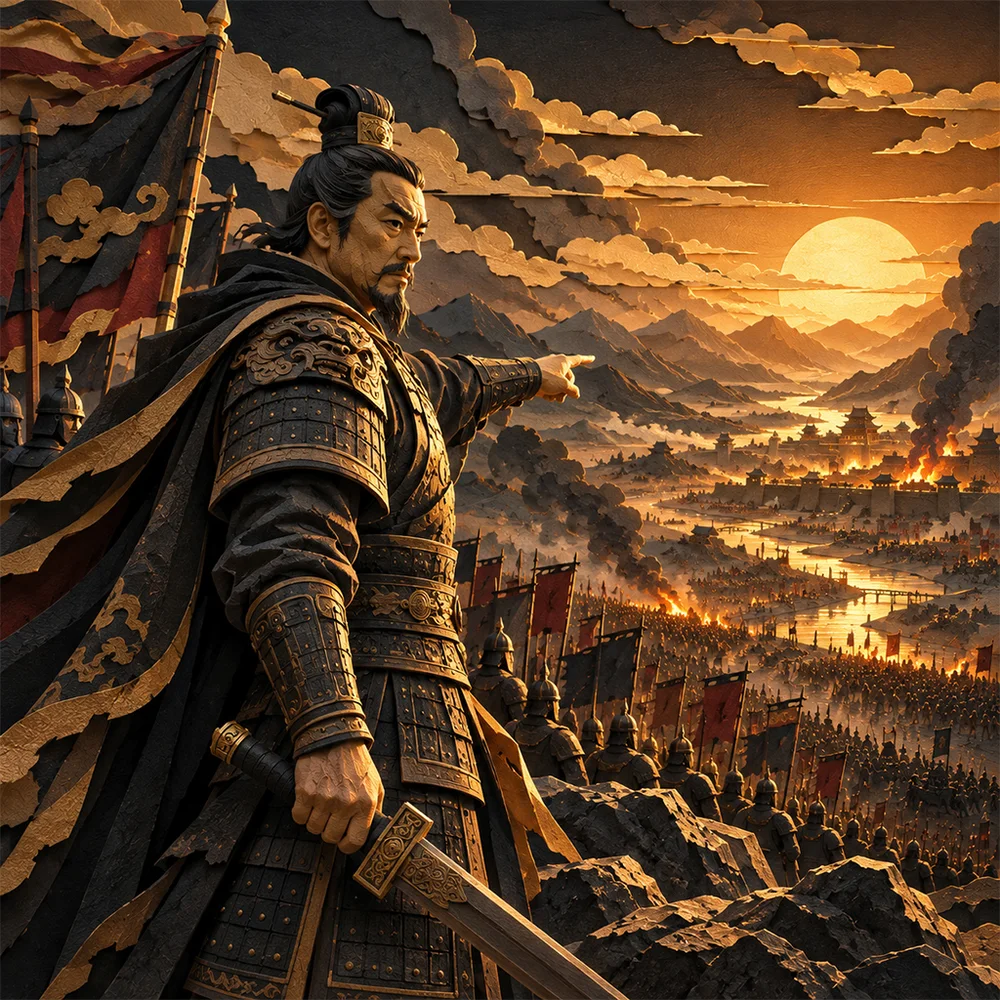
been a small misunderstanding. Not six hundred li of land. Six. That moment—equal parts comedy, tragedy, and political brilliance—tells you almost everything you need to know about the world you are about to enter. Welcome to the Warring States. If you picture ancient history as a slow march of dates and dynasties, this era will quickly change your mind. The centuries between roughly the fifth and third centuries BCE were among the most turbulent—and strangely creative—periods in Chinese history. China at the time was not a single country. It was a patchwork of competing states, each ruled by ambitious kings who watched their neighbors with a mixture of fear, envy, and calculation. Alliances formed and collapsed with dizzying speed. One year you might be drinking wine with a neighboring ruler. The next, you might be invading his capital. In such an environment, survival demanded more than brute force. It demanded strategy. It demanded persuasion. And occasionally, it demanded an astonishing willingness to lie with a straight face. This book tells the stories of the people who mastered those arts. Some fought with armies. Some fought with ideas. And some—like the infamous diplomat Zhang Yi—fought with nothing but words and nerve. One of the great pleasures of studying this period is discovering how personal many of these world-changing events actually were. A clever speech could redirect an entire war. A moment of jealousy could destroy an alliance. A single reform could turn a struggling frontier state into the most terrifying military machine in the region. You’ll meet King Wuling of Zhao, a ruler bold enough to tell his aristocrats that their traditional robes were useless in war—and that they should start dressing like the “barbarians” on horseback instead. The reform shocked the political world, but it transformed Zhao’s army almost overnight. You’ll encounter Yue Yi, the brilliant general whose lightning campaign shattered the powerful state of Qi and nearly erased it from the map. And then you’ll meet Tian Dan, who somehow reversed that catastrophe with one of the most ingenious counterattacks in ancient warfare—an operation so theatrical that it involved flaming oxen charging into enemy ranks. History, it turns out, has a flair for drama. You’ll also meet the thinkers who helped shape how power itself would be understood for centuries. Figures like Han Fei and Li Si argued that states should not rely on noble intentions or moral virtue. Laws, institutions, and authority—cold and precise—were the true foundations of power. Their ideas would later influence the structure of imperial China in ways that still echo today. And then there are the gamblers. Men like Lü Buwei, who quite literally treated politics like an investment portfolio. At one point, he looked at a young prince living in exile and reportedly said something astonishing: “This is a rare commodity worth investing in.” That prince would eventually become Qin Shi Huang—the first emperor of a unified China. Not a bad return on investment. What makes the Warring States period so fascinating is that it sits at a crossroads between myth and modernity. On one hand, it still carries the atmosphere of ancient legend: wandering philosophers, mysterious teachers, heroic generals, and cunning strategists who seem to step straight out of epic stories. On the other hand, the politics feel surprisingly modern. Propaganda. Diplomatic manipulation. Economic pressure. Psychological warfare. Even public opinion campaigns designed to make political decisions appear popular. You’ll see rulers stage-managing crowds to demand that they take the title of king. You’ll see alliances collapse because one state refuses to acknowledge another’s status. You’ll see diplomats who could talk their way into a palace—and occasionally talk their way back out of prison. And sometimes, you’ll see all of those things happen in the same chapter. If you’re looking for a tidy narrative where good always defeats evil and wise rulers always make sensible decisions, I’m afraid this period may disappoint you. The Warring States world was messy. Brilliant people made terrible choices. Foolish decisions occasionally produced brilliant outcomes. Alliances that looked unbreakable dissolved in weeks. Military geniuses sometimes lost everything because of a single misjudgment. And yet, out of all that chaos, something extraordinary emerged. By the end of this story, the endless patchwork of competing kingdoms will disappear. In their place will rise the first unified Chinese empire. That transformation did not happen by accident. It was shaped by centuries of rivalry, experimentation, ambition, and sheer stubborn determination. The figures you’ll meet in these pages—strategists, kings, reformers, schemers—were all participants in that long, unpredictable process. Some of them helped build the future. Some of them resisted it. And some, like Zhang Yi with his infamous “six hundred li” promise, simply enjoyed turning the entire political chessboard upside down. A quick note before we begin. This is not a textbook. You will find history here, certainly—real people, real battles, real political struggles recorded in ancient chronicles. But the goal of this book is not to bury you under academic analysis or footnotes. Instead, we’ll focus on the stories. Because the truth is that this era produced some of the most vivid characters in all of Chinese history. They deserve to be remembered not as dry entries in a timeline, but as people—ambitious, flawed, brilliant, stubborn people—trying to navigate a world where power shifted as quickly as the wind. And occasionally, where a sharp tongue could be more dangerous than an army. Our story begins with exactly that. A man whose greatest weapon was not a sword, a chariot, or a fortress. It was his tongue. After surviving a brutal beating that nearly killed him, he asked his wife a curious question: “Is my tongue still there?” Because as long as it remained intact, he believed he could still change his fate. And, as it turned out, the fate of kingdoms as well. So let’s begin there.
This page presents the cover and public catalog information. Read or listen to the content in Hearin.
Discover the Hearin app ↗Episodes in this collection
- 01
The Power of the Tongue
- 02
Zhang Yi’s Great Deception
- 03
King Wu Ling and the Rise of Zhao
- 04
The Rooster’s Cry and the Thief’s Trick
- 05
Su Qin, The Master of Alliances
- 06
Yue Yi’s Lightning War
- 07
Tian Dan’s Revenge
- 08
The Return of the Jade to Zhao
- 09
Fan Ju’s Rise from Death
- 10
Fan Ju’s Revenge
- 11
Paper Talk of War
- 12
Mao Sui Steps Forward
- 13
Lü Bu Wei’s Great Investment
- 14
Li Si and Han Fei
- 15
Li Mu, The Last Hero of Zhao
- 16
The Dagger Hidden in the Map
- 17
From Warring States to One Empire